admin

About admin
Posts by :

2 Biggest Complaints About Dentures
1. Difficulty eating with dentures
Conventional dentures often result in a reduced biting force. Patients can’t bite as hard, and it creates problems eating certain types of foods.
Also, plastic on the maxillary covers the whole palette for suction, which reduces the effects of patients’ taste buds. Patients complain that they feel as if they lost their taste buds and they cannot tell if food is hot or cold.
Since there are no implants used with conventional dentures, the bones will continue to deteriorate. As the bone deteriorates, the soft tissue changes and the denture won’t fit as well as it did over time.. The denture will then move around and make sore spots. Dentures have to be relined periodically.
The lower denture is also problematic because the tongue and the floor of the mouth move, and it wants to dislodge every time the patient moves his or her tongue. Moreover, as the bone resorbs, the lower ridge gets flatter, making it more difficult for a lower denture to stay in place.
To deal with lower dentures flopping all around, consider implants which will then be able to secure it. For patients complaining on bite forec, implants are the first level of solution.
Then the denture can be retained, and the bite force is directed to the bone and not the soft tissue. The implants also help to stop bone loss. Putting in two to four implants per arch is a great option.
Implants would also help with taste and hot and cold sensitivity that patients lose with conventional dentures. By using six implants on the maxillary arch, the palette is freed from the acrylic denture base that obstructs patients’ taste buds and nerve endings.
Every patient doesn’t opt for implants, however, for a few different reasons. Usually, the cost is an issue since implants are more of an investment than conventional dentures. Another reason could be the patient is in poor health and doesn’t want to put the stress on this or her body with the surgery. Also, some patients have too many medications they take that could interfere with the procedure and recovery.
Nutrition equates to good health. Being able to eat proper foods for nutrition is a bigger deal than so many of us think about.
2. Denture(s) doesn’t fit Properly
Many denture patients think their dentures don’t fit because the denture moves in their mouth when they chew. This movement can make it difficult to eat and cause sore spots due the denture causing friction on the mucosa. To correct the denture fit, patients come in for an adjustment, which results in chair time for which the dental professional usually doesn’t bill for. If billing does occur, then patients typically stop receiving treatment and use denture adhesive.
Many times, however, dentures can fit and function properly. Perceived fit issues often stem from a few critical aspects of denture teeth design and construction.
Denture teeth are historically made flatter and with less anatomy than natural teeth. Teeth are designed this way to prevent rocking of the denture base while the patient is chewing.
Working and balancing describe how denture professionals use bilateral balanced occlusion to stabilize the denture when the patient chews. Denture design often neglects the concept of freedom in centric or the wiggle room our natural teeth have.
Our natural teeth and temporomandibular joint are not locked upon closing in centric. Both can move horizontally, so to speak. When one holds their teeth together in centric, they can wiggle them while holding them together. This is the freedom in centric principle. What is required is denture teeth that can wiggle a little bit.
Not all denture teeth incorporate these occlusal or centric “landmarks.” With something like VITA premium denture teeth, which incorporate the freedom in centric design. He says denture teeth that don’t incorporate freedom in centric cause the denture “waggle” on the gum when the patient chews. The movement gives the patient the mistaken impression that the denture doesn’t fit.
Another area of improvement for fit (and also bite force) is to incorporate lingualized occlusion into the denture design. Wagenseil says it helps people chew like they do with their natural teeth.
“Because lingualized occlusion is more of a mortar and pestle type of approach, it crushes food like natural teeth do,” Wagenseil explains.
Since adopting his denture designs to incorporate lingualized occlusion with freedom in centric functionality, Wagenseil says he doesn’t have as many patients complaining about the fit as before, and the use of adhesive and soft liners has also greatly diminished.
Wagenseil says he consistently delivers dentures with zero to one adjustment, down from the average adjustment rate of two to five.
“You have to look at the economic value of that. If you estimate $400/hour for an American general dentist and a patient comes in for two adjustments, and let’s say they take 30 minutes at a time, that’s $400 off the profit that the office lost. That’s a lot of money,” Wagenseil says. “It is more than what denture tooth is the cheapest. It has to function in relation to the human chewing cycle. The savings are in your adjustment time and costs, which more than offset the denture tooth cost.”
Wagenseil lectures about these concepts to try to help other denture professionals do the same for their patients.
“As a denture professional, we change lives. Patients trust us to help with their chewing ability. Eating is life,” Wagenseil says. “We change lives because we are able to help rehabilitate someone’s chewing cycle. Since incorporating freedom in centric denture teeth, I am able to do so with better predicable results and far less issues.”
Flexible removable partial dentures
When it comes to removable dentures, you want something that fits and functions and looks great for your patient. How you get those qualities, however, depends on the materials you choose. For many cases, particularly those requiring removable partial dentures (RPDs), flexible materials can give you all three.
Flexible partial denture materials are an excellent option for many partially edentulous patients.
Flexible RPD denture materials are not made of acrylic like traditional metal-cast RPDs. Instead, they use a thin thermoplastic, like nylon. The nylon-based materials were first introduced in the 1950s by Valplast and have been an option for partial dentures ever since, particularly for patients allergic to acrylics.
Flexible dentures are thinner than acrylics. Their physical properties make them durable.1Flexible denture materials provide many benefits as well. They are acknowledged as the most biocompatible material for removable dentures. Also, flexible materials do not contain BPA and resist absorbing odors or stains.
While you can make a full or complete denture out of them, most often the flexible material is used for RPDs. Usually, a full denture is made from flexible material only when the patient is allergic to acrylics.
Patients that love flexible partials feel that way because there’s no metal. They think that it is more comfortable once it is well adjusted.
from the patient’s standpoint, flexible dentures are both cosmetic and comfortable. Cosmetic, because they do not display a metal clasp, and comfortable because they are lightweight, and there is neither a metallic taste nor a rigid, bulky appliance in the mouth.
Flexible dentures are beneficial because studies show flexible materials are less destructive than a chrome-based appliance on the natural structures of the mouth. It is thought that the most significant factor in resistance or reluctance to using flexible materials with an RPD is unfamiliarity with the material.
Flexible materials, like nylon, inherently have stress breaking function, making them friendlier and more forgiving to the teeth and tissues under normal use without requiring a complicated design.

Denture Repair
How can dentures become damaged?
The main way dentures are damaged is by dropping them when they are being removed or inserted. Dentures can also become weakened and break if they no longer fit the mouth properly, because of gum shrinkage and change of shape. Subjecting dentures to too much force over a long period of time through teeth grinding, for example, is another cause of damage.
Tips for preventing damage to your dentures
If your dentures no longer fit comfortably, visit a Dental Technician. The longer you wear them when they are not in the correct position, the more likely it is that they may break.
Stand over a towel or a sink of water when removing, inserting or cleaning dentures, which will cushion the fall if you do accidentally drop them
Always take care when handling your dentures to prevent damage
Can they be repaired?
A Dental Technician can usually repair cracked or fractured dentures, insert strengtheners into dentures and remove stains. They can also repair chips in the artificial teeth or replace ones that have broken off. Some clinics offer a postal repair service where you send your dentures to them and they repair them and return them to you on the same day if possible. If your dentures are quite old and have broken several times, it may be necessary to have a new set made. Dentures that have had teeth added or fractured multiple times are generally not very comfortable to wear as they no longer fit that well.
How long does it take to repair damaged dentures?
The time it takes to repair a denture depends on how badly it is damaged. Replacing or repairing a damaged tooth can normally be done by a Dental Technician on the same day. If the denture has suffered a more serious fracture, however, it will take longer to repair. In order to repair your denture it may be necessary for the Dental Technician to take an impression of your mouth with the denture in place. The Dental Technician’s ability to repair a denture depends on the extent of the damage, how old the denture is and what condition it was in before it was broken.
What should you do if your denture breaks?
If possible, keep all the broken pieces together. Don’t use super glue or try and repair the denture yourself.
The problem with do-It-yourself denture repairs
There are lots of denture repair kits available that allow you to fix your denture yourself. This may seem like a quick and convenient solution, but attempting to repair it yourself may end up resulting in further damage and make your denture impossible to repair again and uncomfortable to wear. It is always advisable to have your denture fixed by a qualified professional who has the correct knowledge and equipment to do a good job.
If you’re in the Cape Town area, take advantage of our free Consultation/Assessment. Fill out the inquiry form below and we’ll contact you within 24 hours to arrange an appointment.
To your success!
Denture Implants
Many people have trouble getting their full dentures to stay comfortably and firmly in place. A solution to this common problem is snap in dentures that can be secured in the mouth by means of denture implants for long term stabilization and durability. There are several different options available for securing implant supported dentures. They are mini implants, midi or hybrid implants, and maxi or standard root-form implants. The type of implant that is best suited for each individual patient is largely dependent upon such factors as age, certain diseases and overall health condition, amount of bone resorption (bone loss that occurs after losing teeth), and the patient’s current use of alcohol, drugs, and tobacco products.
Mini implants are becoming vastly popular for numerous reasons. One of the biggest advantages is that they do not require as much bone to be present as other larger types. So, they may still be a possibility even for those who have not had their natural teeth for years. Another plus is that some of the health conditions that prevent some patients from qualifying for other types do not affect their eligibility for minis. Unlike standard rootform implants, they are also relatively painless and are stable and ready for use immediately after the denture implant surgery. This means that the patient can expect full use of his or her dentures, including eating, as soon as they leave the office. The denture implants procedure is very similar for all the different types, it’s just that the mini implants are less invasive.
The technology of minis allows patients to benefit from the ease and comfort of open palate dentures that do not cover the roof of the mouth. The first step in the process of obtaining minis is to make an appointment with a specialist for a consultation in which the entire process will be explained. Then, the patient will undergo X-rays to determine which type of implants is most suitable for the patient’s particular conditions.
If minis are deemed appropriate, the correct diameter and length must be determined according to how much vertical bone is present to hold the implant in place. They can come in four different diameters ranging from 1.8mm to 2.9mm, each of which can come in four different lengths from 10mm to 18mm. No matter the size, generally at least two and as many as four implants are placed in each of the upper and lower regions of the mouth. This is done by drilling a tiny hole into the bone and essentially screwing a titanium screw down into the hole. The titanium screws have little ball-shaped attachments on their tops. The dentures then feature lock mechanisms that snap onto the attachments and keep them tightly in place.
Mini implants are a popular replacement for old dentures. Some older dentures are very uncomfortable, can slip out of place, and often make unwanted noise. Implants are a much more comfortable alternative. They are also much more secure and noiseless, making for worry-free and relaxed wear. And thanks to modern advancements that make them easier to install, they are much more affordable than many may believe upon first learning about them. All of these factors combine to convince many people that the denture implants cost is well worth it.
If you’re in the Cape Town area, take advantage of our free Consultation/Assessment. Fill out the inquiry form below and we’ll contact you within 24 hours to arrange an appointment.
To your success!
Affordable Dentures
Affordable Dentures are offered in a wide variety of denture styles that include full and partial dentures. Experienced dentists will find the best match for your needs.
Full Dentures
Each affiliated Affordable Dentures® practice wants you to have the best denture you can afford. That’s why we offer you a choice of three styles of full dentures, each style having its own distinct advantages.
Economy Dentures
The Economy Denture is the most affordable denture and is selected by many patients. It is processed by our on-site lab and individually fit for you. The dentist and lab technician will determine the size, shape and look of the teeth, based on your needs. The Economy Denture is available with same-day service.
Custom Dentures
The Custom Denture is made with more expensive teeth for a more natural-looking denture. The Denture teeth are set in a wax base so you may try them in to see how the denture will look before it is completed. You may make changes to suit you, consistent with your dental needs. After you have approved the look of your Custom Denture, the lab will custom finish your denture in the permanent acrylic base material. It’s like designing your own smile!
The Custom Denture is often available the same day, however in some cases it may take longer. The practice will inform you of their delivery times.
Premium Dentures
The Premium Denture is the most natural-looking denture. It is made with the best denture teeth available, which are impact, wear and stain resistant. As with the Custom Denture, the teeth are first set in wax for you to try-in. Changes may be made at the time of try-in. After you have approved the look of your Premium Denture, the lab will then custom finish your denture in the permanent acrylic base material. Again, it’s like designing your own smile.
The Premium Denture is also often available the same day, however in some cases it may take longer. The practice will inform you of their delivery times.
Partial Dentures
Some practices also offer two types of partial dentures – Cast Metal and Acrylic partials.
Cast Metal Partial Denture
The Cast Metal Partial Denture is the best partial denture, and is stronger, less bulky and offers the best fit. The Cast Metal partial is fabricated using a metal framework to which the on-site laboratory will attach higher grade denture teeth. This partial denture will take from two to three weeks to make since our special metal framework is made by an outside laboratory.
Acrylic Partial Denture
Acrylic Partial Dentures are a more affordable partial, but they tend to feel more bulky. The partial denture has an acrylic base upon which the teeth are set and is attached to natural teeth with small metal clasps. The practice staff will show you which teeth are available to place on the denture.
The acrylic partial denture is often available the same day.
If you’re in the Cape Town area, take advantage of our free Consultation/Assessment. Fill out the inquiry form below and we’ll contact you within 24 hours to arrange an appointment.
To your success!
Partial Dentures
A removable partial denture is usually made to replace one or more teeth, and is customized to a patient’s specific requirements. Removable partial dentures restore a person’s natural appearance and greatly improve the ability to chew and speak clearly.
A partial denture may be tooth-supported or tooth and tissue-supported. There are significant differences between these two types of dentures. These differences are best explained by your Denturist. The number of teeth remaining, the position and the stability of the teeth are only a few of the factors that help to determine what style or type of partial denture would be best for you.
Partials can be made of different materials, including acrylics and a metal/acrylic combination. Acrylic partials are usually used as a transitional or temporary replacement of missing teeth, depending on your personal circumstances. The metal/acrylic partial- commonly called a cast partial is usually a more rigid and permanent style of denture. The metal is either a highly compatible chrome cobalt alloy or titanium, which are booth ultra thin, light and very strong.
All partials are designed to be removable and should be removed nightly to contribute to a healthy oral environment. With newer designs, materials and techniques, partials are more comfortable than ever before. Ask your Denturist about the many designs available.
The Benefits of Partials
Partial dentures do not harm remaining natural teeth. A partial denture may prevent your natural teeth from shifting or drifting into the space left by the loss of a natural tooth. In fact, a partial denture may help maintain the position of your natural teeth by providing them with additional support.
If you’re in the Cape Town area, take advantage of our free Consultation/Assessment. Fill out the inquiry form below and we’ll contact you within 24 hours to arrange an appointment.
To your success!
False Teeth
Choosing false teeth is an individual decision, together with a qualified dental professional. You would need to decide on false teeth make of porcelain or plastic teeth. Each separate false teeth choice has its own advantages and disadvantages. Your dental professional will discuss the options available to you taking into account your unique requirements.
1. False teeth that consist of either metal or plastic removal plates with artificial teeth fitted to them. If you have gaps between teeth then you will only need to have partial false teeth sets. If all of the teeth have been removed form the upper or lower jaw, a full set of false teeth will be required.
2. A second option is to choose bridges, which is one or two teeth that can be anchored to the adjacent teeth.
3. A third choice is to have implants, this is metal ‘pegs’ attached to the jawbone, to which dentures or bridges are clipped or screwed.
After extraction and before dentures or false teeth can be fitted the gum needs to heal properly, this can take anything from 3 to 6 months.
With many advances in dentistry there have been vast improvements in the way false teeth are made and how they look. Your dental professional will check the resulting false teeth to see how natural looking they are, that the fit is right, comfortable and the overall effect is pleasing to the eye.
Once you agree to have false teeth, and the gums have healed sufficiently to have dentures made, an appointment will be made so that the dental professional can make a full impression the gum area where the false teeth will fit. Taking an impression will decide on the shape and the size of the gum where the teeth are to be fitted. This will be sent to the dental laboratory for the first impression to be made.
In the subsequent appointments your dental professional will check on whether the lower and upper alignment of the teeth is correct when biting down onto the gum.
By the time of the third visit the will have set the teeth into a wax base in order for your dental professional to check and decide if the false teeth will look real, they are then returned to the laboratory for the finishing off, the laboratory will then replace the existing wax base for the plastic dental base, this will then fit tightly to the gums. The fourth visit adjustment will be made, because periodically the plastic will shrink.
After the dentures have been fitted, care should be taken to ensure that the last as long as possible. You will also need to get used to using your dentures, you might find some difficulty when eating at first, probably notice some minor speech changes.
To accustom your self to your new false teeth you should begin eating soft food and gradually introduce more robust foods as you feel more comfortable using them.
Caring for your new false teeth is an important part of the process. Bearing in mind that although porcelain teeth will last longer they are prone to chipping if dropped or knocked against any hard object.
Whether they are plastic of porcelain handle them with care.
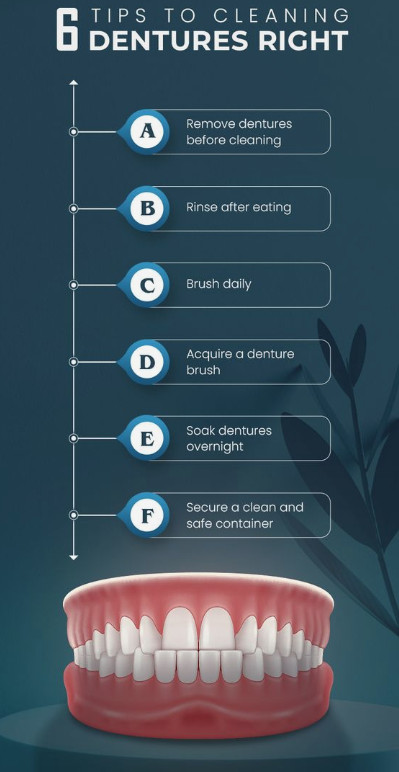
Here are some tips on caring for your false teeth:
Place a small towel on a flat surface and work over that so that if you drop your dentures they have some cushioning under them and they cannot get damaged.
Remove them from your month and brush them daily
Do not use any abrasive cleaners or toothpastes that are abrasive they will leave scratches. Use cleaners that are specially designed for false teeth.
Do not use boiling water or place them in the dishwasher, hot water will damage and warp them. Use a special sterilizing agent designed for dentures
Partial dentures should be removed before cleaning your normal teeth and then be cleaned separately.
When false teeth are not in your mouth for any period of time. Place them in a glass of water or dental cleaner. False teeth left to go dry will become brittle, and can crack or break.
Keep your dentures in a safe place out of reach of children and pets, also by having a special place to keep them you will avoid misplacing them. This may seem obvious but people do tend to forget.
Annual check-ups with your dental professional should be maintained, small adjustments may need to be made as the gums may change and your false teeth may no long fit correctly.
If you’re in the Cape Town area, why not take advantage of our free Consultation/Assessment? Fill out the inquiry form below and we’ll contact you within 24 hours to arrange an appointment.
To your success!
Dentures: Before and After
Cosmetic Dentistry Can Have An Amazing Effect On Your Looks
Check our Before and After Pictures
If you’re in the Cape Town area, why not take advantage of our free Consultation/Assessment? Fill out the inquiry form below and we’ll contact you within 24 hours to arrange an appointment.
1 2